Methodology

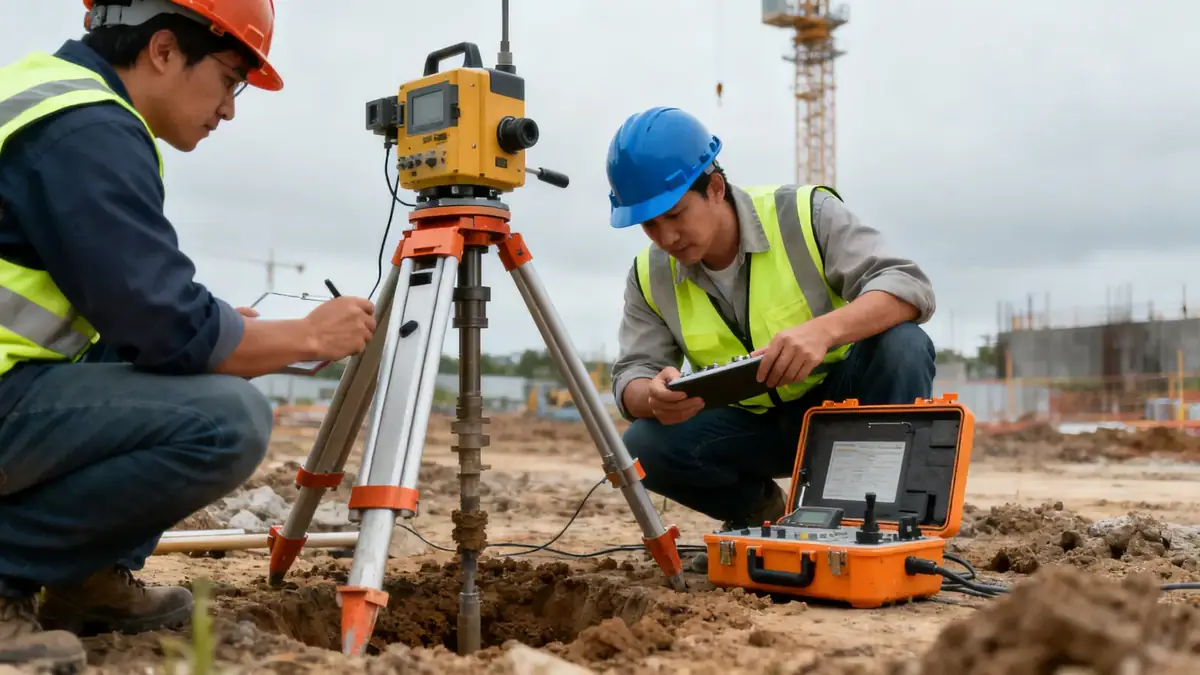
Our methodology for soil mechanics laboratory projects in Houston follows a systematic approach grounded in ASTM D1586 for standard penetration testing (SPT) and continuous sampling at 1.0 to 1.5 m intervals. We integrate SPT blow counts (N60) with laboratory classification (ASTM D2487) to define soil profiles typical of the region—interbedded clays, silts, and sands. Seismic hazard is evaluated per ASCE 7-22 Site Class criteria, with peak ground acceleration (PGA) values up to 0.15g for the Houston area. Our soil mechanics laboratory services include in-situ testing, groundwater monitoring, and advanced laboratory programs to support foundation design for residential, commercial, and industrial projects across Harris County.
Reference Technical Parameters
| Parameter | Reference Value |
|---|---|
| Predominant soil type | Expansive clay (CH), interbedded silty sand (SM) |
| Maximum seismic acceleration (PGA) | 0.10–0.15 g (ASCE 7-22) |
| Typical groundwater level | 1.5–4.5 m below ground surface |
| Bedrock depth | > 300 m (deep sedimentary basin) |
| Typical N60 range | 4–20 blows/ft (clays); 10–30 blows/ft (sands) |
Local Considerations — Houston
Houston's geology is dominated by the Beaumont Formation, consisting of highly plastic clays with high shrink-swell potential—critical for slab-on-grade foundations. Shallow groundwater (typically 1.5–4.5 m) requires dewatering considerations for excavations. Seismic hazard is low to moderate (PGA ~0.10–0.15g per ASCE 7-22), but site amplification due to soft soils warrants Site Class D or E classification. Contrasting conditions exist between downtown's overconsolidated clays and western suburbs' loose sands. Common challenges include differential settlement in residential subdivisions and foundation heave from moisture changes. Our granulometry & atterberg testing quantifies plasticity and gradation to guide mitigation strategies.
Request a Quote
Our team reviews your project and issues an initial report at no cost.
Or write us directly at [email protected]
Services in Houston
Locations covered in Houston
Applicable Standards
- ASTM D1586 (Standard Penetration Test)
- ASTM D2487 (Unified Soil Classification System)
- ASCE 7-22 (Minimum Design Loads for Buildings)
- International Building Code (IBC) 2021
- City of Houston Public Works Design Manual
Frequently Asked Questions
What soil types are typically encountered in Houston?
Houston soils are predominantly high-plasticity clays (CH) of the Beaumont Formation, with interbedded silty sands and organic deposits near waterways. These expansive clays pose risks of heave and shrinkage, requiring careful moisture control and foundation design.
Is seismic analysis mandatory for Houston projects?
Yes, per ASCE 7-22 and the IBC, seismic design is required for most structures in Houston, even though the region has low-to-moderate seismicity. Site-specific soil amplification factors (Site Class D or E) must be determined via soil mechanics laboratory testing.
When is a soil mechanics laboratory study required in Houston?
A geotechnical investigation is typically mandated for commercial buildings, multi-family developments, and any structure with deep foundations or expansive soil exposure. The City of Houston and Harris County require soil reports for permit issuance in most cases.