Methodology

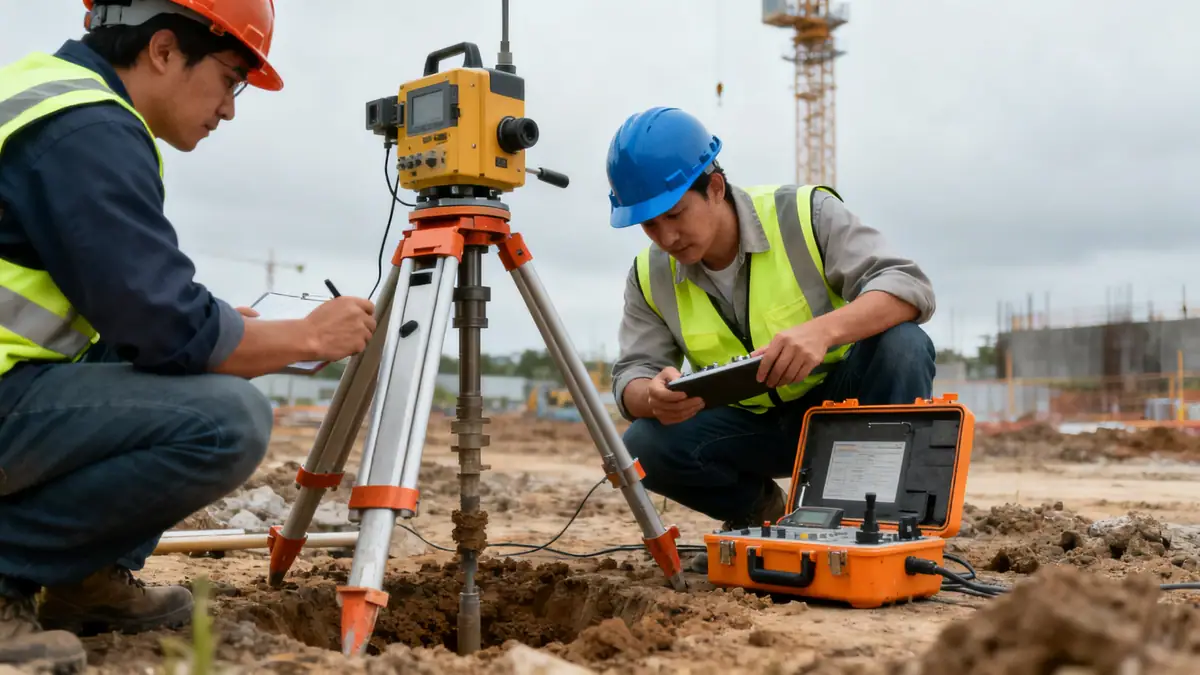
Our methodology for soil mechanics laboratory in Atlanta integrates field exploration, in-situ testing, and laboratory analysis. We perform soil borings using hollow-stem augers and SPT sampling at 1.5 m intervals per ASTM D1586, reaching depths of 15–30 m depending on project requirements. Undisturbed tube samples are collected for advanced testing. In the laboratory, we classify soils via granulometry & atterberg tests, determining grain size distribution and plasticity indices. Compaction characteristics are evaluated through proctor & cbr testing to assess bearing capacity for pavements and foundations. All procedures follow relevant ASTM standards to ensure data quality and reproducibility.
Reference Technical Parameters
| Parameter | Reference Value |
|---|---|
| Predominant Soil Type | Residual micaceous silty sands and clays (Piedmont) |
| Maximum Seismic Acceleration (PGA) | 0.2g to 0.3g (ASCE 7-16 Site Class C–D) |
| Typical Groundwater Level | 3–10 m below ground surface, variable with topography |
| Bedrock Depth | 5–25 m (gneiss, schist, granite) |
| Typical N60 Range | 10–50 blows/ft in residual soils |
Local Considerations — Atlanta
Atlanta's Piedmont geology presents weathered crystalline rocks overlain by residual soils with varying thickness. Steep topography in areas like Buckhead contrasts with flat floodplains along the Chattahoochee River. Groundwater levels fluctuate seasonally, impacting excavation dewatering. Seismic design per ASCE 7-16 requires site-specific acceleration parameters due to variable soil stiffness. Our team addresses these local conditions through targeted field investigations, including observation wells and seismic cone penetration testing. For projects in downtown Atlanta or Midtown, we integrate triaxial & consolidation testing to evaluate shear strength and settlement potential under building loads.
Request a Quote
Our team reviews your project and issues an initial report at no cost.
Or write us directly at [email protected]
Services in Atlanta
Locations covered in Atlanta
Applicable Standards
- ASTM D1586 (Standard Penetration Test)
- ASCE 7-16 (Minimum Design Loads for Buildings)
- ASTM D2487 (Unified Soil Classification System)
- ASTM D422 (Particle-Size Analysis)
- Georgia State Minimum Standard Building Code
Frequently Asked Questions
What soil types are commonly encountered in Atlanta?
Atlanta's Piedmont region predominantly features residual soils derived from weathering of gneiss, schist, and granite. These include micaceous silty sands (SM), low-plasticity clays (CL), and occasionally high-plasticity clays (CH) in lower-lying areas. Saprolite, a decomposed rock retaining original structure, is also common at depth.
Is seismic design required for buildings in Atlanta?
Yes, per ASCE 7-16 and the Georgia State Building Code, seismic design is required for most structures in Atlanta. The region is classified as Seismic Design Category B or C, with mapped spectral accelerations (S_s) of 0.2–0.3g. Site-specific analysis may be needed for important buildings or soft soil sites.
When is a geotechnical investigation mandatory in Atlanta?
Geotechnical investigations are required for most new commercial buildings, multi-family residential projects, and any structure exceeding three stories or with unusual loads. Local ordinances also mandate soil reports for subdivisions and infrastructure projects. Early investigation helps avoid costly foundation issues.