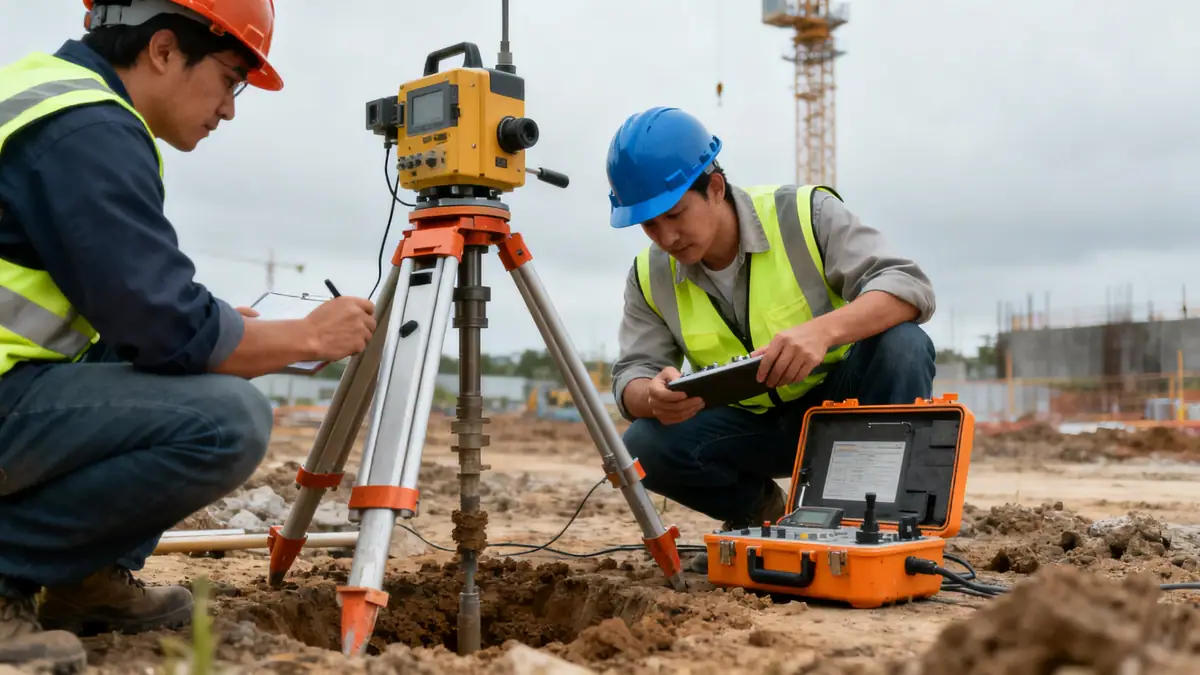
Methodology

Our methodology for soil mechanics laboratory in Austin follows a systematic approach tailored to local conditions. Initial site reconnaissance and subsurface exploration using standard penetration testing (SPT) per ASTM D1586 are conducted at intervals of 1.0 to 1.5 meters, typically reaching depths of 8 to 15 meters for residential projects. Soil samples are analyzed in our accredited laboratory for index properties, including moisture content and density. For deeper foundations, advanced methods such as soil mechanics laboratory testing are employed to assess bearing capacity and settlement. All procedures adhere to ASTM and local building codes, ensuring compliance and reliability.
Reference Technical Parameters
| Parameter | Reference Value |
|---|---|
| Predominant Soil Type | Clay (expansive), silt, sand |
| Maximum Seismic Acceleration (PGA) | 0.1g to 0.2g (per ASCE 7) |
| Typical Groundwater Level | 5 to 15 feet below surface |
| Bedrock Depth | 20 to 100 feet (variable) |
| Typical N60 Range (SPT) | 4 to 30 blows/ft |
Local Considerations — Austin
Austin's geology is dominated by Cretaceous-age limestone and marl, overlain by expansive clays of the Taylor Group. The Balcones Fault Zone introduces variable bedrock depth and potential for karst features. Groundwater levels fluctuate seasonally, with shallow aquifers near the Colorado River. Seismic activity, though moderate, requires adherence to ASCE 7 for site-specific response spectra. Our team has extensive experience with these conditions, from downtown high-rises to suburban subdivisions. For regional expertise, we also serve clients through our soil mechanics laboratory en Houston facility, offering consistent quality across Texas.
Request a Quote
Our team reviews your project and issues an initial report at no cost.
Or write us directly at [email protected]
Services in Austin
Applicable Standards
- ASTM D1586 (Standard Penetration Test)
- ASCE 7 (Minimum Design Loads for Buildings)
- International Building Code (IBC)
- City of Austin Land Development Code (LDC)
Frequently Asked Questions
What are the typical soil types encountered in Austin?
Austin soils are predominantly expansive clays, silts, and sands, with limestone bedrock at varying depths. The clay content can cause significant volume changes with moisture, requiring careful foundation design.
Is seismic testing required for projects in Austin?
Yes, per the International Building Code and ASCE 7, site-specific seismic hazard analysis may be required for certain structures. Austin lies in a moderate seismic zone, with peak ground accelerations up to 0.2g.
Are geotechnical studies mandatory for construction in Austin?
While not always legally mandatory for all projects, most building permits require a geotechnical report for structures with foundations, especially in areas with expansive soils or near the Balcones Fault Zone.