
Methodology
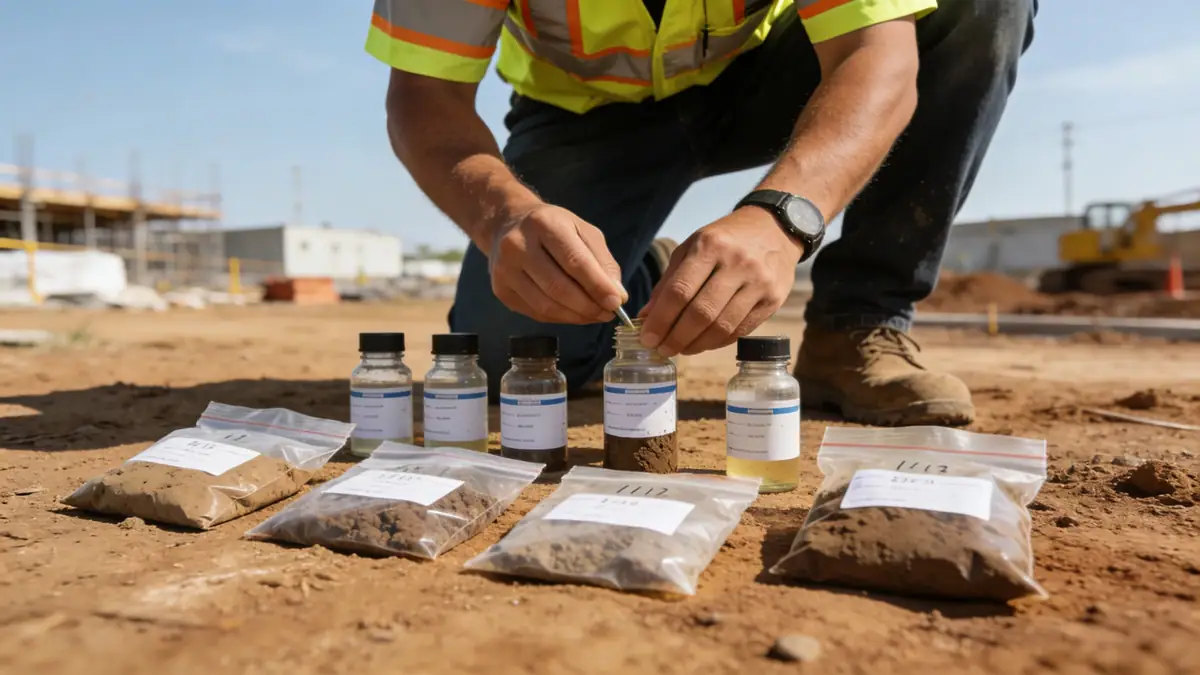
Our methodology for soil mechanics laboratory projects in Tempe Arizona follows ASTM D1586 for standard penetration testing, ensuring consistent N60 values for bearing capacity assessments. Field exploration includes soil borings and test pits, with samples retrieved for laboratory analysis. At our on-site laboratory, we conduct classification tests (granulometry, Atterberg limits) and strength tests (direct shear, triaxial) following applicable ASTM standards. For comprehensive geotechnical evaluations, we integrate field and lab data with local seismic considerations. Learn more about our soil mechanics laboratory approach.
Reference Technical Parameters
| Parameter | Reference Value |
|---|---|
| Predominant soil type | Silty sands (SM) and poorly-graded sands (SP) with gravel |
| Maximum seismic acceleration (PGA) | 0.20g to 0.30g (ASCE 7 seismic design category C/D) |
| Typical groundwater level | 10–30 m below grade (deep, but may rise near canals) |
| Typical N60 range (SPT) | 10–30 blows/ft for sands; 5–15 for silts |
| Bedrock depth | Generally > 50 m (deep alluvial basin) |
Local Considerations — Tempe Arizona
Tempe Arizona lies within the Basin and Range province, characterized by deep alluvial deposits from the Salt River. The soil profile is highly variable laterally, with sand-dominated lenses near the river and more cohesive silts/clays in older terraces. Seismic hazard is moderate, with peak ground accelerations up to 0.30g per ASCE 7. Liquefaction potential exists in loose, saturated sands near the water table. Our team routinely evaluates these conditions for projects ranging from high-rise buildings near Arizona State University to residential subdivisions in southern Tempe. For broader regional context, visit our soil mechanics laboratory en Phoenix page.
Request a Quote
Our team reviews your project and issues an initial report at no cost.
Or write us directly at [email protected]
Services in Tempe Arizona
Applicable Standards
- ASTM D1586 (Standard Penetration Test)
- ASCE 7 (Minimum Design Loads for Buildings)
- IBC 2021 (International Building Code)
- ASTM D2487 (Unified Soil Classification System)
- ASTM D698 (Standard Proctor)
Frequently Asked Questions
What types of soil are most common in Tempe Arizona?
The predominant soils are silty sands (SM) and poorly-graded sands (SP) with varying amounts of gravel and occasional clay lenses. These alluvial deposits originate from the Salt River and can exhibit significant lateral variability.
Do I need a soil mechanics study for a small residential project in Tempe?
Yes, even for single-family homes, a geotechnical investigation is recommended to assess bearing capacity, settlement potential, and seismic site class. The City of Tempe may require a soils report for permit approval, especially in areas with variable soil conditions.
What seismic design considerations apply in Tempe Arizona?
Tempe falls under Seismic Design Category C or D per ASCE 7, with a maximum considered earthquake spectral acceleration (SDS) of 0.50–0.75g. Site-specific soil amplification must be evaluated based on shear wave velocity or SPT N-values.