Methodology
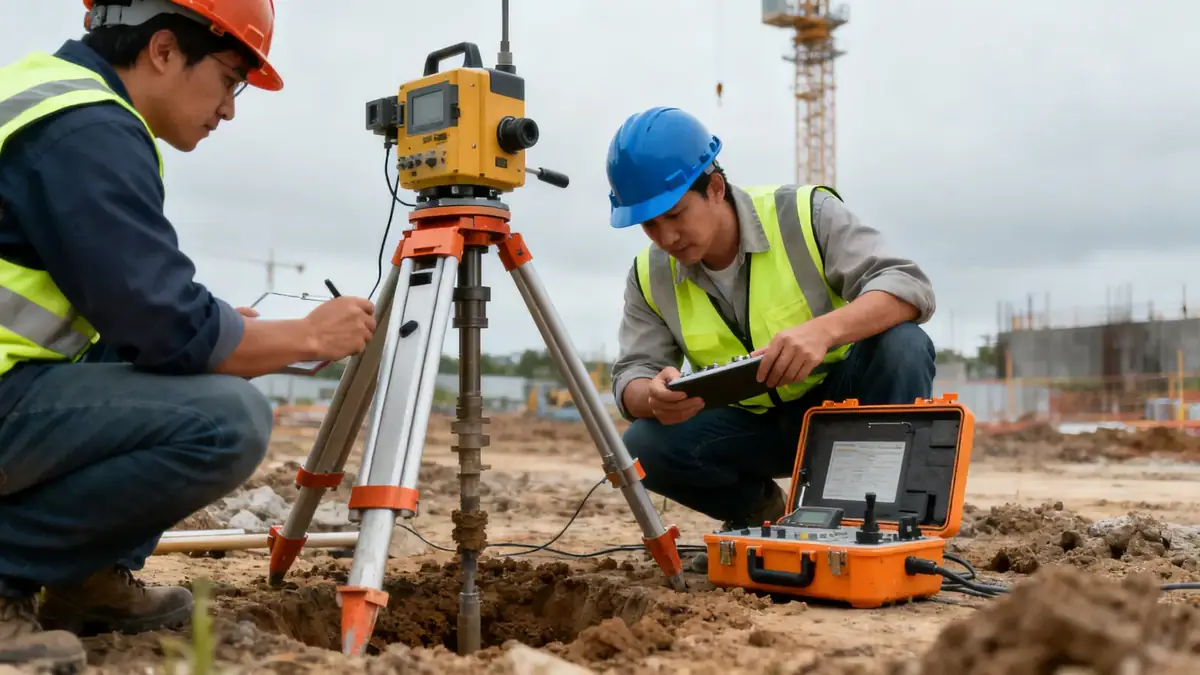
Our approach to soil mechanics laboratory work in Richmond Virginia follows rigorous protocols aligned with ASTM standards. For subsurface exploration, we employ standard penetration testing (ASTM D1586) with sampling intervals of 1.0–1.5 m, reaching depths of 8–15 m for residential structures and up to 30 m for industrial projects. In cohesive soils, we retrieve undisturbed tube samples for consolidation and triaxial testing. Laboratory procedures include grain-size analysis via sieve and hydrometer (ASTM D6913/D7928), Atterberg limits (ASTM D4318), and compaction tests (ASTM D698/D1557). All data are synthesized into clear reports that support foundation design and regulatory compliance. Our soil mechanics laboratory capabilities ensure every parameter is measured with precision.
Reference Technical Parameters
| Parameter | Reference Value |
|---|---|
| Predominant soil type | Silty sand (SM) and clayey sand (SC) with micaceous silt |
| Maximum seismic acceleration (PGA) | 0.18g (ASCE 7-16, Site Class C–D) |
| Typical groundwater level | 3–6 m below grade, variable with season |
| Bedrock depth | 10–25 m (Piedmont crystalline rock) |
| Typical N60 range (SPT) | 8–30 blows/0.3 m in residual soil |
Local Considerations — Richmond Virginia
Richmond Virginia's geology is dominated by Piedmont residual soils—silty sands and clayey silts derived from weathered schist and gneiss. These materials often exhibit high plasticity and variable density, requiring careful laboratory characterization for accurate bearing capacity and settlement estimates. Groundwater levels fluctuate with the James River and local topography, typically encountered at 3–6 m depth. Seismic hazard is moderate (PGA ~0.18g per ASCE 7), necessitating site-specific soil response analysis. The city's urban core features occasional fill and buried utilities, while suburban developments encounter deeper weathering profiles. Common challenges include expansive clay behavior and shallow rock in western areas. For broader context, our soil mechanics laboratory en Philadelphia team addresses similar Piedmont conditions with complementary expertise. We also offer granulometry & atterberg testing to classify these complex soils.
Request a Quote
Our team reviews your project and issues an initial report at no cost.
Or write us directly at [email protected]
Services in Richmond Virginia
Applicable Standards
- ASTM D1586 (Standard Penetration Test)
- ASTM D698/D1557 (Proctor Compaction)
- ASCE 7-16 (Minimum Design Loads and Associated Criteria for Buildings and Other Structures)
- IBC 2021 (International Building Code)
Frequently Asked Questions
What soil types are most common in Richmond Virginia for foundation design?
Richmond Virginia's Piedmont region primarily features residual silty sands (SM) and clayey sands (SC) derived from weathered metamorphic rock. These soils often contain mica and exhibit variable plasticity. Proper classification through Atterberg limits and grain-size analysis is essential for predicting settlement and bearing capacity.
How does seismic code ASCE 7 apply to soil mechanics laboratory testing in Richmond Virginia?
ASCE 7-16 maps Richmond Virginia with a maximum considered earthquake (MCE) PGA of approximately 0.18g. Site classification (A–F) based on shear wave velocity or SPT N-values determines the design response spectrum. Our laboratory provides site-specific soil parameters—including stiffness and strength—to support seismic design per code.
Are soil mechanics laboratory studies mandatory for building permits in Richmond Virginia?
While the Virginia Uniform Statewide Building Code (USBC) does not explicitly mandate soil testing for all projects, most local jurisdictions require geotechnical reports for structures with shallow foundations, basements, or significant earthwork. A comprehensive laboratory analysis helps mitigate risks from expansive soils and variable bedrock depth.