
Methodology
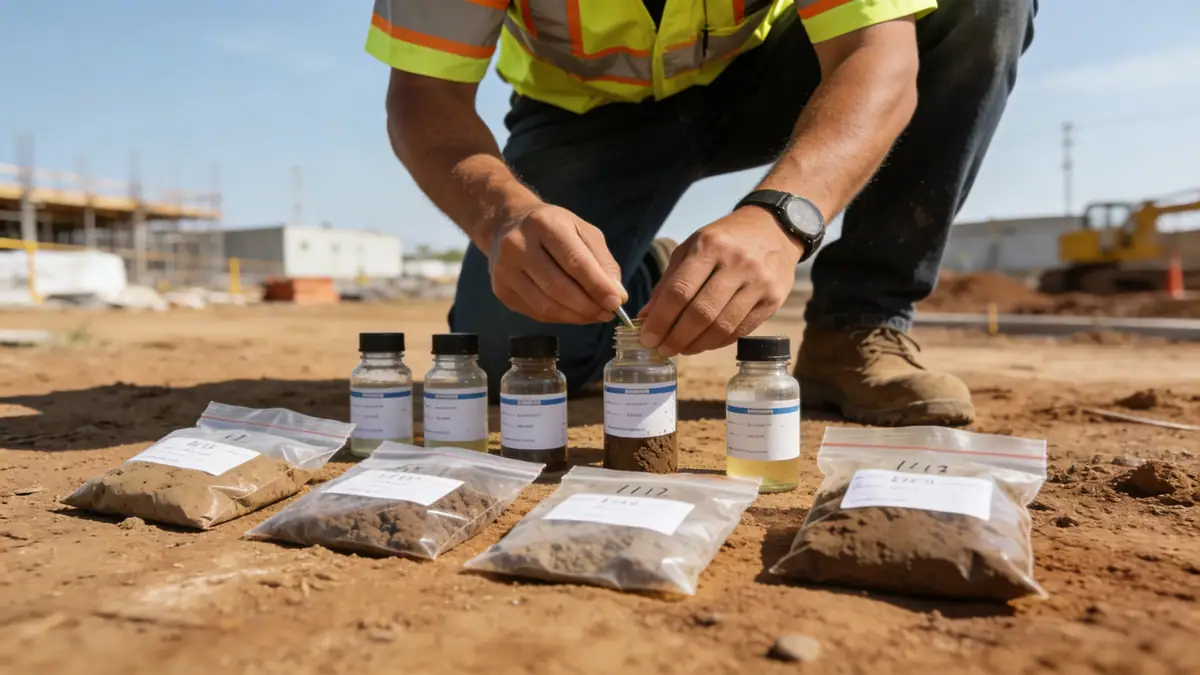
Our methodology begins with a detailed review of existing geologic maps for Pasadena, then progresses to field exploration including SPT borings and CPT soundings. We collect undisturbed and disturbed samples for laboratory analysis. For further detail on our core testing capabilities, see our soil mechanics laboratory overview. All work follows ASTM D1586 for SPT and local seismic design parameters per ASCE 7-22.
Reference Technical Parameters
| Parameter | Reference Value |
|---|---|
| Predominant soil type | Alluvial sand and gravel with silt layers |
| Maximum seismic acceleration (PGA) | 0.40g (ASCE 7-22 Site Class D) |
| Typical groundwater level | 6–12 m below surface |
| Bedrock depth | 15–30 m (Tertiary sedimentary rock) |
| Typical N60 range | 10–30 blows/0.3 m |
Local Considerations — Pasadena California
Pasadena's soils are predominantly alluvial fans from the San Gabriel Mountains, with interbedded sands, gravels, and silts. The groundwater table fluctuates seasonally but commonly sits between 6 and 12 meters deep. Seismic hazards include strong ground shaking and potential liquefaction in loose saturated sands. Older neighborhoods near the Raymond Fault require site-specific studies. Our team has extensive experience in this geologic setting. For comprehensive geotechnical services from our regional base, see soil mechanics laboratory en Los Angeles. Additional testing methods include granulometry & atterberg analyses to classify fine-grained soils.
Request a Quote
Our team reviews your project and issues an initial report at no cost.
Or write us directly at [email protected]
Services in Pasadena California
Applicable Standards
- ASTM D1586
- ASCE 7-22
- California Building Code (CBC 2025)
- ASTM D2487 (USCS)
- ASTM D6913 (sieve analysis)
Frequently Asked Questions
What types of soil are commonly found in Pasadena, California?
Pasadena's subsurface consists mainly of alluvial deposits from the San Gabriel Mountains: poorly graded sands (SP), silty sands (SM), gravels (GP/GW), and occasional clay layers (CL). These soils are often loose to medium dense and can be susceptible to liquefaction during strong seismic events.
How does seismic code ASCE 7-22 affect soil testing in Pasadena?
ASCE 7-22 requires site-specific ground motion parameters, including PGA and spectral accelerations. For Pasadena, the default Site Class D applies unless proven otherwise. Soil mechanics laboratory testing (shear wave velocity, SPT N-values) is essential to determine the correct site class and design response spectrum.
Is a geotechnical study mandatory for residential construction in Pasadena?
Yes, for most new buildings and additions. The California Building Code (CBC) requires a geotechnical investigation to address seismic hazards, bearing capacity, and settlement. Pasadena's municipal code also mandates reports for projects near fault zones or with expansive soils.