Methodology
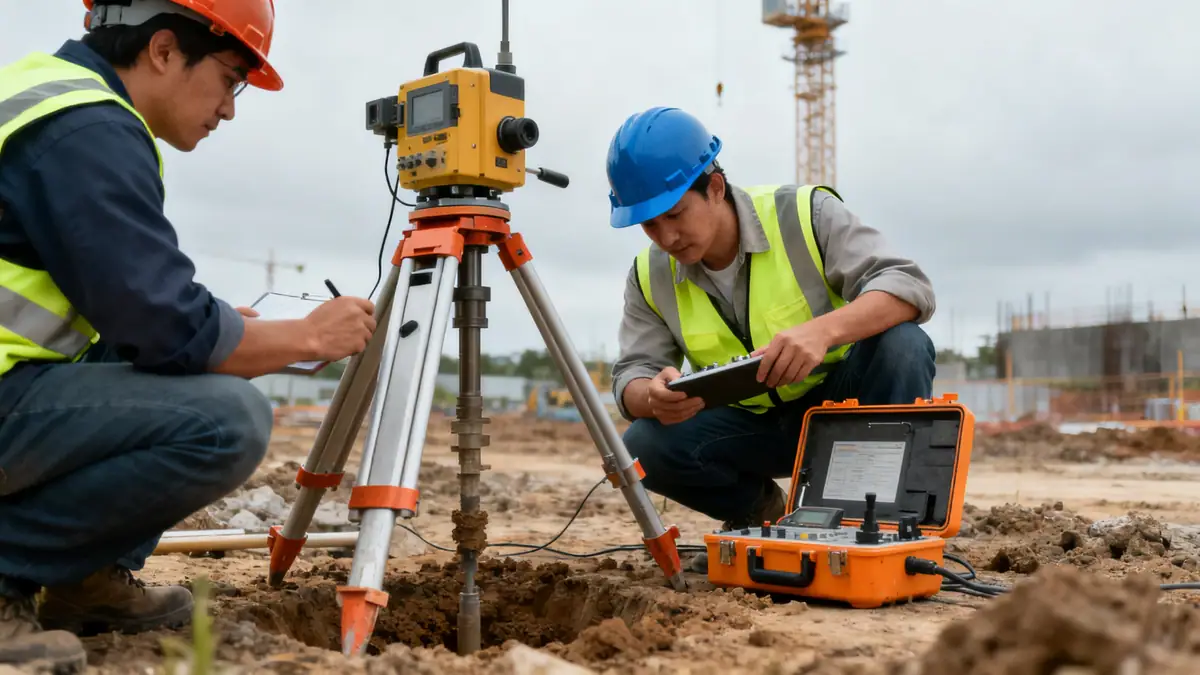
Our methodology for projects in Oceanside integrates standard penetration testing (SPT) per ASTM D1586 with continuous sampling at 1.5 m intervals to capture stratigraphic variability. We complement this with cone penetration testing (CPT) for real-time soil behavior classification. All field data are processed at our soil mechanics laboratory, where index properties, strength parameters, and consolidation characteristics are determined. This dual approach ensures robust characterization of the coastal and alluvial deposits typical of the region.
Reference Technical Parameters
| Parameter | Reference Value |
|---|---|
| Predominant soil type | Silty sand to poorly graded sand (SM-SP) |
| Maximum seismic acceleration (PGA) | 0.30–0.40 g (ASCE 7 Site Class D) |
| Typical groundwater level | 1.5–4.0 m below ground surface |
| Bedrock depth | 15–30 m (Friars Formation) |
| Typical N60 range | 8–25 blows/0.3 m |
Local Considerations — Oceanside
Oceanside's subsurface is dominated by Quaternary alluvium and terrace deposits, with the Friars Formation bedrock at depth. The shallow water table—often encountered at 1.5–4.0 m—requires dewatering considerations for excavations. Seismic hazard is significant due to the nearby Rose Canyon and Elsinore faults, with peak ground accelerations up to 0.40 g per ASCE 7. Coastal areas exhibit loose sands prone to liquefaction, while inland neighborhoods like Rancho del Oro feature stiffer clays. Typical challenges include soft ground for shallow foundations and lateral spreading risks. For broader regional context, our soil mechanics laboratory en Los Angeles provides similar expertise across Southern California. Complementary services such as granulometry & atterberg are often required for fine-grained soil classification.
Request a Quote
Our team reviews your project and issues an initial report at no cost.
Or write us directly at [email protected]
Services in Oceanside
Applicable Standards
- ASTM D1586 (Standard Penetration Test)
- ASCE 7 (Minimum Design Loads and Associated Criteria for Buildings)
Frequently Asked Questions
What soil types are commonly found in Oceanside?
Oceanside's soils are predominantly silty sands and poorly graded sands (SM-SP) from alluvial and terrace deposits, with occasional clay layers inland. The shallow groundwater table and loose coastal sands require careful evaluation for liquefaction potential.
How does seismic activity affect soil mechanics testing in Oceanside?
Oceanside lies near active faults, with PGA values up to 0.40 g per ASCE 7. Our testing incorporates cyclic triaxial and resonant column tests to assess dynamic soil properties, ensuring designs comply with seismic code requirements for Site Class D conditions.
Are geotechnical studies mandatory for residential construction in Oceanside?
While not universally required for single-family homes, most jurisdictions in Oceanside recommend or mandate soil reports for new construction, especially in areas with high liquefaction or expansive soil risk. Lenders often require them for loan approvals.