
Methodology
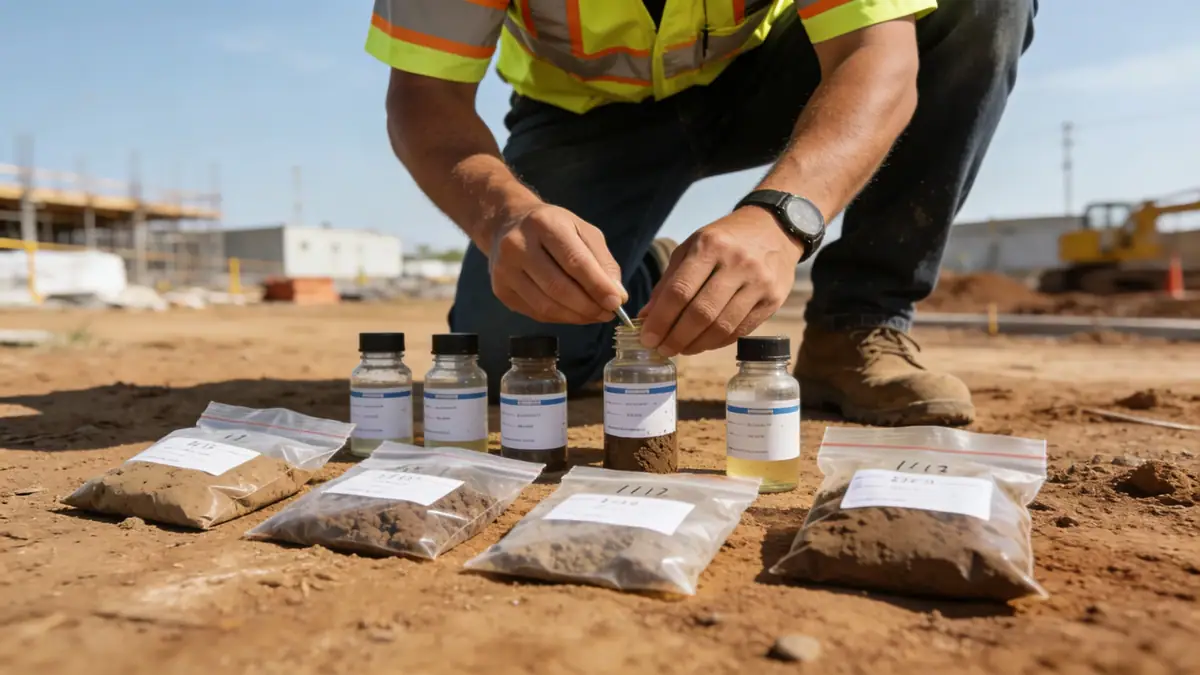
Our methodology for soil mechanics laboratory in Irvine follows standardized protocols such as ASTM D1586 for Standard Penetration Tests. We conduct borings at depths up to 30 meters for industrial projects, with SPT sampling intervals of 1.0 to 1.5 meters. For detailed soil profiling, we employ Cone Penetration Tests (CPT) at 2 cm intervals to identify stratigraphy and groundwater conditions. This systematic approach ensures reliable data for foundation design and seismic hazard assessments, as required by local regulations.
Reference Technical Parameters
| Parameter | Reference Value |
|---|---|
| Predominant soil type | Alluvial sands and silty clays |
| Maximum seismic acceleration (PGA) | 0.4g (ASCE 7) |
| Typical groundwater level | 3–6 m below surface |
| Bedrock depth | Variable, 10–30 m |
| Typical N60 range | 5–30 blows/ft |
Local Considerations — Irvine
Irvine's geology is dominated by Quaternary alluvium from the Santa Ana River, with interbedded sands, silts, and clays. Shallow groundwater (3–6 m depth) can impact excavation and foundation design. Seismic hazards include strong ground shaking (PGA up to 0.4g per ASCE 7) and potential liquefaction in loose sandy layers. The San Joaquin Hills to the west feature more competent bedrock, while eastern areas near the river have deeper alluvium. For projects requiring regional support, our team also provides soil mechanics laboratory en Los Angeles services. Typical challenges include foundation settlement in compressible clays and lateral spreading risks in seismic events.
Request a Quote
Our team reviews your project and issues an initial report at no cost.
Or write us directly at [email protected]
Services in Irvine
Applicable Standards
- ASTM D1586
- ASCE 7
- California Building Code (CBC)
Frequently Asked Questions
What are the typical soil conditions in Irvine?
Irvine's soils are primarily alluvial sands, silts, and clays deposited by the Santa Ana River. Groundwater is shallow, typically 3–6 m deep. The area is seismically active with high PGA values requiring detailed site-specific studies.
Is seismic design mandatory for projects in Irvine?
Yes, all structures in Irvine must comply with the California Building Code and ASCE 7, which mandate seismic design based on site-specific soil parameters. Soil mechanics laboratory testing is essential to determine liquefaction potential and site class.
When is a soil mechanics laboratory study required in Irvine?
Most new construction and major renovations in Irvine require a geotechnical investigation per local building codes. Studies are mandatory for commercial buildings, multi-story residential, and infrastructure projects to assess bearing capacity and seismic risks.