
Methodology
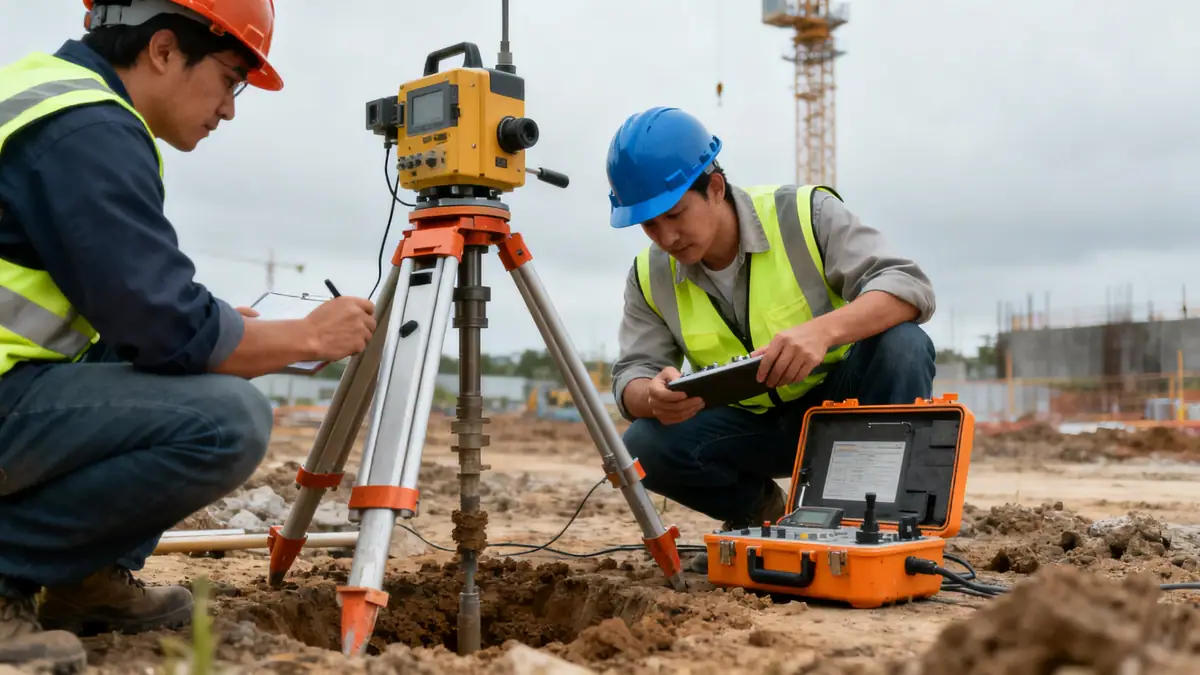
Our methodology for soil mechanics laboratory investigations in Hialeah begins with a thorough review of existing geological maps and nearby project data. We then deploy a combination of standard penetration tests (SPT) per ASTM D1586 and cone penetration tests (CPT) to characterize soil stratigraphy and strength. Continuous sampling at 1.5-meter intervals ensures detailed profiling. Laboratory testing, including soil mechanics laboratory analyses—such as grain size distribution and Atterberg limits—complements field data. Our integrated approach provides a comprehensive understanding of Hialeah's subsurface conditions, enabling informed engineering decisions. All procedures adhere to ASTM standards and local building codes.
Reference Technical Parameters
| Parameter | Reference Value |
|---|---|
| Predominant soil type | Sandy limestone and silty sands (Miami Limestone formation) |
| Maximum seismic acceleration (PGA) | 0.18g (ASCE 7-16, Site Class C) |
| Typical groundwater level | 1.5–3.0 m below ground surface (varies seasonally) |
| Bedrock depth | 5–15 m (limestone) |
| Typical N60 range (SPT) | 10–35 blows/0.3 m (sandy soils) |
Local Considerations — Hialeah
Hialeah's geology is dominated by the Miami Limestone formation, characterized by porous limestone bedrock overlain by sandy soils. The shallow water table (1.5–3.0 m) poses challenges for excavation and foundation construction, requiring dewatering plans and corrosion-resistant materials. Seismic hazard is moderate (PGA 0.18g per ASCE 7), with site class C typical. Older neighborhoods may have undocumented fill, necessitating careful subsurface investigation. New developments near the Palmetto Expressway often encounter variable soil conditions. Our soil mechanics laboratory services in Hialeah address these local factors, ensuring compliance with Florida Building Code and ASCE 7. For broader regional context, see our soil mechanics laboratory en Miami page.
Request a Quote
Our team reviews your project and issues an initial report at no cost.
Or write us directly at [email protected]
Services in Hialeah
Applicable Standards
- ASTM D1586
- ASCE 7-16
- Florida Building Code (2023)
- ASTM D2487 (Unified Soil Classification System)
Frequently Asked Questions
What soil types are commonly found in Hialeah?
Hialeah predominantly features sandy soils underlain by Miami Limestone, a porous limestone. Silty sands and sandy limestone are common, with occasional organic layers in low-lying areas. The water table is shallow, typically 1.5–3.0 m deep.
Is seismic design required in Hialeah?
Yes, per the Florida Building Code and ASCE 7-16, Hialeah falls under Seismic Design Category B with a PGA of 0.18g. Site-specific seismic analysis is recommended for critical structures, though most projects require only simplified procedures.
Are soil studies mandatory for construction in Hialeah?
The Florida Building Code requires geotechnical investigations for most structures, especially those with shallow foundations or significant loads. Local municipalities may have additional requirements. A proper soil study ensures foundation safety and code compliance.